Warps Staple (Prof. Ingrid Malbranc)
 Technical
appears in the Andean Middle Horizon and currently applies Pitumarca in Cuzco
is a tissue of two elements in which the warp does not traverse the entire length d  and the fabric continuously as usually happens, but it changes color as links to other fabric of another color. The frames also work intermittently thus achieving full-color forms. Development: This seminar will draw up a little web of simple geometric patterns using two or three contrasting colors.
 Materials: frame 50 x 50 cm. approx., scissors. Other materials included
Cavandoli, Macramé (Prof. Ludmila Islander)
 The thread or cord fabric woven with more or less complex knots called Macramé. Is done by hand and used to create crafts from very small to very large, such as potting media, belts, bracelets, necklaces, bags, lamps and curtains. Cavandoli
The Macramé belongs to, and is to work a single node (the scallop ) changing colors for different designs and shapes . With it you can do from geometric designs to curves.  Development: Making a medallion with geometric designs and a flower. History, calculus and mounted thread designs. Materials: waxed cord three coils of different colors, scissors, lighter or matches, masking tape, work support (can be press table, wood with nails, tergopol with pins, rack, etc.).
 H
ardanger with Barghello (Prof. Elba B Rocco) traditional embroidery techniques
Development. Barghello, Hardanger. Making a table runner that is between rustic and delicate.
Materials: a meter of burlap combed the color you want and 3 macramé yarn colors combined with the fabric. Blunt needle No. 18 or 20. finite-tipped scissors. KIT: $ 25
Needle tatting (Prof. Nora Winter) 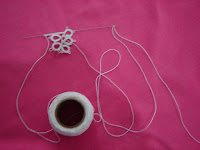
The variety is tatted lace. It is found under the name of "fit to the shuttle" in Spain, "tatting" in Great Britain, "occhi" in Italy and "makuk" in the East. Technically a series of knots and baguillas on a single thread, threaded on one or two shuttles. The proposal of this seminar is to use a needle instead of thread out of the shuttle or shuttle to
 simplify certain movements and allow greater ease of development.
can perform different types of lace to the ends of different items and objects. Is currently recovering its use for applications in jewelry.
Development: Making a tatted piece
Materials: rhinestones needle No 12 cotton thread.
Afternoon Shift (from 14.30 to 17.30 pm), Saturday and Sunday Tapestry Plant (Prof. Mary Ruggieri)  The proposal is leave it to our creative power. This is not a traditional tapestry, but to let the elements are "ordered" from our suggestions and agreed to go with that building this tapestry unconventional basically done with plant material that you can add other elements such as wool, threads, etc..
Development: From various branches and we will be putting together a simple bonds is  previous structure that will serve as the basis for the tissue. The design will individual participant. The idea is to leave to our creative side and free to play with the imagination and the material available. Try to go in this game guiding them.
Materials: The cost of the plant material is $ 15. If you want you can take a branch in particular that they are willing to include in the work, like wool or wire or other element that serves to the tissue.
Tubular fabric in three layers (Prof. Delia Gomez Velis and Bethlehem)  tubular fabric is known as a double cloth, in this case we will see in three layers. It is a technical reference for Lequan, Cochabamba, Bolivia. It works in face warp, which alternate three groups of warps of different colors that are shown or hidden according to the drawing, making a double fabric is indispensabl
 and have knowledge of tubular tissue Development: Making a belt design in three colors. Reading Materials
Grid: Frame boy, weave wire macramé or similar in the following sequence: [A B 1 1 1 C 2 A B C 2 2 ] 23 times. Heald place in each caring for the warping order, being placed six systems Heald. A shuttle with color, shovel, 3 rods. Scissors tapestry twine Trama (Prof. Alexandra Deppe)  The plot twist or twine is also known as "chain" or "Peruvian point." It is used in weaving fabrics to ensure the beginning and end of a cloth, baskets and special way to intertwine the fibers and textiles Creoles and conducting ethnographic peleros and tapestries. For failing to Heald or shed some technical specialists refer to as the Pretzel and is easy to perform. In Argentina dominated the tapestries made this technique in the province of Formosa and are made by women Qom (Toba) in wool. There is also work in fiber Wichí chaguar by women but are less abundant than those of wool. The idea of \u200b\u200bthe workshop is to "draw" with this technique some simple designs as an introduction to the mat and face frame techniques. Development: Making a tapestry fabric twine Materials: rectangular frame of any size, without nails. Bring plotted with no cross or circular warp heddles semigorda wool (cashmilon or sheep) and several skeins of colored wool semigorda of 50 gr. Spindle and Distaff Spun (Prof. Mario Guerrieri)
 yarn involves gathering and tying loose strands of material, so as to form continuous filament with torsion and thickness suitable for obtaining the desired strength and elasticity. The yarn is crafted with the spindle and the distaff, which was a rod in which a portion was fixed (called snowflake) of the fiber that would be spun fleece
Recognition, Cleaning and preparation of the fleece, carded , prehilado, Spun S and Z, spinning from one end, two-ply yarn, yarn unconventional mixtures
Development: Making spinning of a cape, two ply yarn, spindle and spinning wheel, yarn unconventional mixtures
Materials: $ 10 (fleece, spindle, distaff)
Nuno Felt (Prof. Maria de los Angeles Zarantonello)
Nuno Felt is a technique that involves the inclusion of fleece in a tissue, preferably  you natural fibers, gauze, silk, linen, etc.
are achieved thus different effects, textures and designs to be applied to clothing or decoration. Development: work on different tissues: Borders, fringes, inclusions.
Making a cotton gauze scarf with fleece colors.
Materials: $ 25. (Gauze, merino fleece, natural and colors, threads, etc.).